
Education
John Spencer
John Spencer develops classroom creativity through sketchnote explainers, maker activities, writing prompts, and tutorials for teachers. Its approach combines practical, lesson-ready formats with research-backed guidance, emphasizing creative problem-solving alongside curriculum and standards. It is most useful to educators seeking adaptable professional-development ideas for classroom planning; activities should be tailored to local curriculum, student needs, and school policies.
Hidden GemEducation
Editorially reviewed:
Quiet lately
This source has been less active recently, but remains included for its editorial value.
Quiet lately

Viewer engagementModerate engagement
Based on 20 recent videos
Assessed 15 September 2026
Editorial focusClassroom & K-12 Learning Structured Lessons
Editorial note
WorthWatch verdict
Best for
K–12 educators seeking creative, adaptable lesson ideas
Strength
Practical prompts that make creative learning easier to plan
Consider if
you want to adapt activities for your students, curriculum, and classroom context
Recent videos
Latest from the source
Deep Dive
John Spencer: Creative Routines for Everyday Classroom Practice
Main focus
John Spencer translates classroom creativity into usable teaching ideas, from sketchnote explainers and maker prompts to writing exercises and professional-development tutorials. The emphasis stays on helping educators build imaginative problem-solving into existing lessons and standards.
Why it matters
Teachers seeking fresh ways to make lessons more participatory can draw on prompts and tutorials designed for direct classroom adaptation. The mix of creative practice and research-informed guidance makes it a useful planning companion for educators balancing curriculum demands with student agency.
Style
Sketchnote-led explanations turn teaching concepts into visually clear, approachable lessons, while prompts invite students to build, write, and test ideas. The tone is encouraging and practical, with formats aimed at fitting into day-to-day teaching rather than requiring a wholesale redesign.
Consistency
Across a focused archive of teacher-facing resources, the subject range remains closely tied to creative learning, practical classroom routines, and educator development. The formats vary while serving a consistent goal: making creative teaching more actionable.
- Classroom creativity
- Maker activities and problem-solving
- Writing prompts and student imagination
- Sketchnote explainers
- Teacher professional development
- Creative thinking alongside curriculum standards
Editorial note
Adapt activities to students’ ages, accessibility needs, curriculum requirements, and local school policies. Research-informed approaches are most useful when considered alongside the evidence and the needs of a particular classroom.
Related channels
More in Classroom & K-12 Learning and Structured Lessons
 Top Pick
FocusClassroom & K-12 Learning Structured Lessons
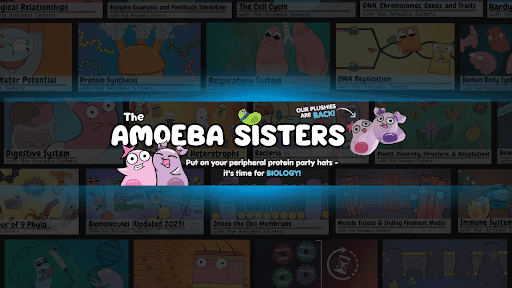
Amoeba Sisters
Short-form biology lessons teach core high school concepts through humor, animated visuals, comics, and memorable analogies. The sisters explicitly...
 Top Pick
FocusClassroom & K-12 Learning STEM Problem Solving
Cognito
GCSE science and maths lessons are organised as concise, exam-oriented explainers, covering material aligned most closely with AQA while aiming to...
 Top Pick
FocusSTEM Problem Solving Classroom & K-12 Learning
Mario's Math Tutoring
Focused math tutorials break down classroom topics into concise lessons designed to help students catch up, review missed material, and reduce study...

FocusSTEM Problem Solving Classroom & K-12 Learning
Mr H Tutoring
Algebra, geometry, trigonometry, and pre-calculus are taught through a mathematics tutoring-oriented channel for middle and high school learners. The...